Anfatec Logo

Level AFM

Level AFM

Flexible AFM system for scientific research with multiple imaging modes and advanced spectroscopy.

User-defined experiments and full expandability with Anfatec options such as KPFM, closed-loop operation, automated sample motion, acoustic enclosure, and environmental control.

Individually configured to meet specific user requirements.

System Datasheet

Performance Parameters

  • Lateral (X–Y) resolution: ≤ 2 nm (on standard samples)
  • Height (Z) resolution: ≤ 0.2 nm (atomic steps)
  • Maximum scanning range (X–Y): > 50 µm
  • Maximum scanning range (Z): > 5 µm

Sample Handling

  • Maximum sample dimensions (L × W): ≥ 20 × 20 mm
  • Maximum sample height: ≥ 5 mm
  • Manual positioning range (X–Y): ≥ 10 mm × 10 mm

System Equipment & Accessories

  • Controller: 24-bit ADC and DAC conversion
  • Enclosure: acoustic and electromagnetic shielding
  • Surveillance system: dual cameras (top and side view)
  • Software: 3D data acquisition and analysis
  • Computer: industrial-grade PC with Windows 10 Pro (64-bit)
  • Accessories: cantilevers of various types, empty cantilever boxes, tweezers, sample holders
Example Images from some more advanced applications:

Kelvin Probe Force Microscopy

Kelvin Probe Force Microscopy (KPFM) is a technique that allows to detect work function differences on surfaces as well as local charges. It has undergone a long development and there are many different kind of KPFM operation modes known. All KPFM mode have in common, that an alternating plus a dc bias is applied between tip and sample. The forces resulting from the alternating voltage are used to generate a feedback signal that controls the value of the dc bias. Usually, a signal of a lockin amplifier is compensated to zero with the KPFM feedback.

Two of the available Anfatec SPM controllers offer KPFM capability: the AMU2.6 controller type offers it for lockin frequencies up to 1 MHz and the AMU2.9-HighSpeed controller version offers it for frequencies up to 10 MHz. In both cases, the lockin card includes four independent 2-phase lockin amplifiers. They can be configured in a way, that AM-KPFM, Side band KPFM on the 2nd cantilever resonance or FM-KPFM experiments can be performed.


KPFM
KPFM
AM-KPFM image of an Al / silicon surface taken with a DEP01 cantilever with Pt coating. Topography (left) and Surface Potentoal (right). The Al wire is buried into the silicon surface and shows the more positive surface potential. The silicon is covered with a thin oxide laser and the surface potential slightly decays in dependence on the distance from the Al edge.


KPFM
KPFM
Resonance enhanced FM-KPFM image of an Al / silicon surface taken with a DEP01 cantilever with Pt coating. Topography (left) and Surface Potentoal (right). In comparison to the AM-KPFM image, the potential contrast is better localized due to the side band detection. There are also more potential features visible on the Al surface. The potential difference between Al and Si is measured with 190 mV.

Magnetic Force Microscopy(2nd trace imaging)

In Magnetic Force Microscopy (MFM), each line of the images is taken twice: the first trace is used to get the topography information. The 2nd trace is following the topography in a certain height of several nm and mainly detects long range interactions, such as interactions caused by magnetic forces. MFM employs cantilevers with a magnetic coating, usually CrCo coated silicon tips.

>
MFM
MFM
Topography (left) and MFM Amplitude (right) images of a Bruker reference sample for MFM. Image Size: 1.5 �m x 1.5 �m.


MFM
MFM
Topography (left) and MFM Phase (right) images of a Bruker reference sample for MFM. Image size: 40 �m x 40 �m.

Electrical Force Microscopy

The field of electrical force detection in AFM is very wide. Here, we have selected a technique, where the electrical forces are separated from the topography with modulated voltage applied between tip and sample.


EFM Mode (Single trace)


EFM Single EFM Single EFM Single
Topography FWD EFM Signal 1st Harmonic FWD EFM Signal 2nd Harmonic FWD


EFM Mode (Dual trace = Lift Mode)


EFM Dual EFM Dual EFM Dual
Topography FWD 2nd Trace Amplitude FWD 2nd Trace Phase FWD

Optional features for Anfatec AFMs

  • EFM Module for AM-KPFM and FM-KPFM
  • passive Vibration isolation table under the microscope
  • active Vibration isolation table under the microscope
  • separate tip contact for EFM
  • closed loop scanner with sensors
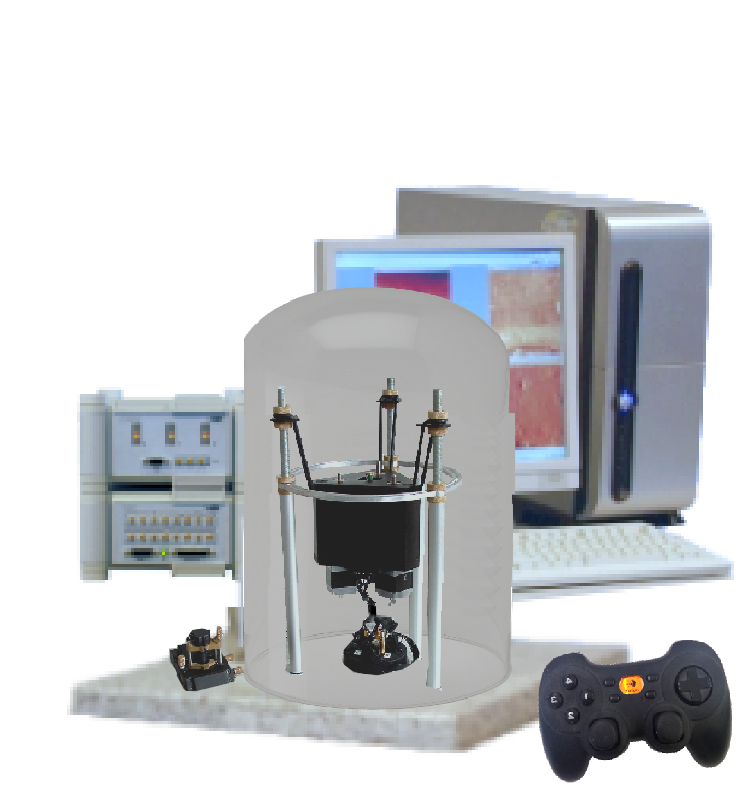
  • glass bell jar for acoustic protection
  • glass bell jar for vacuum application
  • Aluminum ground plate with pump for vacuum applications
  • acoustic enclosure with/without humidity and temperature control
  • additional cantilever packages and gratings
  • enhanced LFM mode sensitivity (spot like laser diode)
  • external lockin amplifier(s)
  • Humidity sensor for glass bell jar
  • EFM head with IR laser diode for semiconductor EFM applications

Low noise laser module

Thermal noise spectrum of stiff cantilever taken with SXM Software
Force constant calibration based on thermal noise spectra with kLever software

Software

Anfatec Present

  • filter functions high pass, low pass, Fourier, noise, mean,..
  • enhanced line and plane correction
  • data import and export
  • shows image information
  • histogram for brightness /contrast
  • colour palette variable
  • 3D view
  • line and roughness analysis, FFT
  • copy function to other windows tools
  • unit cell correction(also for Omicron pictures)
  • analysis of integrated spectroscopy data
Present Logo