Anfatec Logo

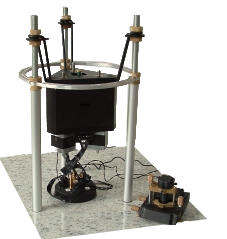
High Speed - Atomic Force Microscope

Faster. Smarter. Made for Research & Industry.

Request Quote

or Information

Anne D. Mueller
High Speed AFM2

Engineered for fast, reliable nanoscale imaging.

Designed for researchers and industry, the HighSpeed AFM delivers ultra-fast imaging with sub-nanometer resolution and versatile measurement modes.

  • High-speed scanning: up to 5–20× faster than standard AFMs
  • Supports Kelvin Probe & Magnetic Force Microscopy — ideal for advanced material analysis :contentReference
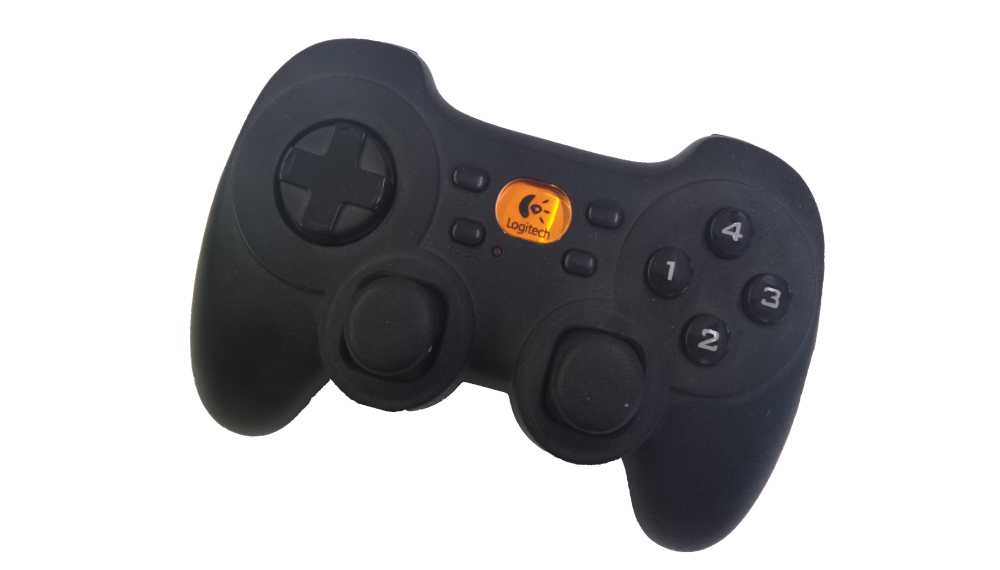
  • Effortless operation – joystick control with intuitive navigation and laser alignment :contentReference
  • Modular design with optional upgrades for education, research, or industrial use — scalable to your needs

Advanced Features


High resolution Contact mode

Students learn the principle of the laser deflection system and how to adjust the system.They can take an image in contact mode and check the difference between slow feedback speed (constant height mode) and fast feedback speed (constant force mode). With distance curves, they can calculate the sensitivity of the system and calculate the contact force used in the experiments.

Contact Mode AFM Sample Image 1 Contact Mode AFM Sample Image 2
High resolution Dynamic mode

For the daily use of AFM, the imaging in dynamic mode is more common than the contact mode, because tip and sample are spared.The students learn the relation between force constant and resonance frequency, repeat some knowledge about harmonic oscillating systems, resonances and Q-factors and get introduced to the basics of lockin amplification technique, which is used to evaluate the amplitudes and phase shifts.In the acquired images, material contrast can be obtained in the phase image in addition to the topography.

Dynamic Mode AFM Sample Image 1 Dynamic Mode AFM Sample Image 2
Current-AFM Mode

Current-AFM measures electrical current flowing between tip and sample during scanning. This mode is used to study conductive properties of materials at the nanoscale.

Lateral force mode

In contact mode, lateral forces are detectable and can be used to find material contrast in inhomogeneous samples. The experiment explains how LFM is working and the students learn to understand, how to distinguish between topography-related signals and material-related signals.

Lateral Force Microscopy Image 1
Kelvin Probe Force Microscopy

Kelvin Probe Force Microscopy (KPFM) is a technique that allows to detect work function differences on surfaces as well as local charges. It has undergone a long development and there are many different kind of KPFM operation modes known. All KPFM mode have in common, that an alternating plus a dc bias is applied between tip and sample. The forces resulting from the alternating voltage are used to generate a feedback signal that controls the value of the dc bias. Usually, a signal of a lockin amplifier is compensated to zero with the KPFM feedback. Two of the available Anfatec SPM controllers offer KPFM capability: the AMU2.6 controller type offers it for lockin frequencies up to 1 MHz and the AMU2.9-HighSpeed controller version offers it for frequencies up to 10 MHz. In both cases, the lockin card includes four independent 2-phase lockin amplifiers. They can be configured in a way, that AM-KPFM, Side band KPFM on the 2nd cantilever resonance or FM-KPFM experiments can be performed.

KPFM Sample Image 1 KPFM Sample Image 2

AM-KPFM image of an Al / silicon surface taken with a DEP01 cantilever with Pt coating. Topography (left) and Surface Potentoal (right). The Al wire is buried into the silicon surface and shows the more positive surface potential. The silicon is covered with a thin oxide laser and the surface potential slightly decays in dependence on the distance from the Al edge.

KPFM Sample Image 3 KPFM Sample Image 4

Resonance enhanced FM-KPFM image of an Al / silicon surface taken with a DEP01 cantilever with Pt coating. Topography (left) and Surface Potentoal (right). In comparison to the AM-KPFM image, the potential contrast is better localized due to the side band detection. There are also more potential features visible on the Al surface. The potential difference between Al and Si is measured with 190 mV.

Magnetic Force Microscopy (2nd trace imaging)

In Magnetic Force Microscopy (MFM), each line of the images is taken twice: the first trace is used to get the topography information. The 2nd trace is following the topography in a certain height of several nm and mainly detects long range interactions, such as interactions caused by magnetic forces. MFM employs cantilevers with a magnetic coating, usually CrCo coated silicon tips.

Magnetic Force Microscopy Image 1 Magnetic Force Microscopy Image 2

Topography (left) and MFM Amplitude (right) images of a Bruker reference sample for MFM. Image Size: 1.5 µm x 1.5 µm.

Magnetic Force Microscopy Image 3 Magnetic Force Microscopy Image 4

Topography (left) and MFM Phase (right) images of a Bruker reference sample for MFM. Image size: 40 µm x 40 µm

Electrical Force Microscopy

EFM separates electrical forces from topography using modulated voltage applied between tip and sample. It enables the study of capacitance variations and electrical properties.

Electrical Force Microscopy Image 1 Electrical Force Microscopy Image 2 Electrical Force Microscopy Image 3
Joystick

Controller for the fast Approach of Tip and Sample

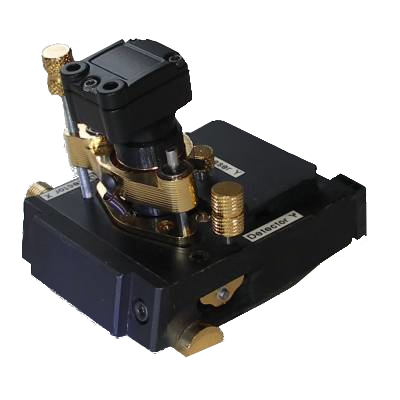
AFM-Head

Image of the AFM head with the compact Top View camera design and Sample Illumination

Camera Specification

FeatureSpecification
Camera Sensor2592 x 1944 Pixel (5 MPixel)
Camera Sensor TypeCMOS color
Optical Sensor Dimensions3.620 mm x 2.720 mm (4.53 mm diagonal)
Pixel Size1.4 µm
Optical Resolution< 4 µm
Pixel Resolution500 nm
Field of View1.3 mm x 1 mm
Filterblue filter (for DNC laser suppression)
Sensor Interface and Power SupplyUSB 2.0
Optional Features
  • Vibration isolation table under the microscope
  • Hardware scanner linearisation (feed forward type)
  • Glass bell jar for acoustic protection
  • Additional cantilever packages and gratings
  • Enhanced LFM mode sensitivity (circular laser diode)
  • Additional LockIn amplifier for dynamic EFM or MFM
  • Implemented Kelvin feedback
  • Current amplifier for conductance AFM incl. power supply
  • SPIP - Scanning Probe Image Processor - with all customer specific modules from Imaging Metrology
  • 2nd TFT monitor
  • Low noise laser module
  • Graph with logarithmic frequency axis (1 Hz to 1e13 Hz) and linear noise density scale (~19–20 dB). Shows two curves (Exact in blue, Approx in red) merging with a steep drop at high frequencies

    Low Noise Laser Module for High-Speed AFM. The module effectively reduces laser backscatter and noise, significantly improving signal fidelity within the AFM detection system. It enables more precise determination of mechanical properties and delivers reliable results, especially in measurements involving sensitive samples or liquid environments.

Camera Images
TGF11
Mubar Zoom
Camera image of a the AFM cantilever above a TGF11 calibration grating with 10 µm pitch illuminated by a white LED.

Camera image of a calibration glass slide with 10 µm scale bar illuminated by a white LED.

850nm PS
350nm PS
Image of self-assembled 850 nm polystyrene spheres coated with silver. These grating-like structures refract visible light in different colors. The black spots correspond to silver islands.

Image of self-assembled layers of 350 nm polystyrene spheres coated with silver. Different layers (mono- or bilayer) give rise to different colors. The black spots consist of silver islands.

NSC15-bar
SUB bar
Image of a µmash NSC15 cantilever. The tip apex (pointing towards the camera) is shining red.

Image of a gold coated high-speed SU8 cantilever.

850nm white
850nm green
850nm Greenwhite>
Illuminated by a white LED. Illuminated by a green LED. Illuminated by both, white and green LED.
Image of a monolayer of hexagonal packed self-assembled 850 nm polystyrene spheres coated with silver. These grating-like structures refract visible light in different colors depending on the layer orientation and the wavelength of the incident light.


The AFM-head comes with an off-axis sample illumination by two different LEDs on opposite sides. Depending on which LED is active, different sphere layer orientations are shining bright.

Go to Image Gallery

Request Quote

or Information

Anne D. Mueller